Ferric Instrument Works San Diego, Calif.

A new class of instruments on your phone.

The most powerful device ever made is already in your pocket, and almost nothing on it takes making music seriously. These are purpose-built instruments that turn the phone's constraints and its power into a new approach entirely — field instruments, in your pocket, strong enough to record whole tracks.

02Why they exist

The tools the phone deserved

I

The pocket supercomputer.

You carry the most powerful device ever made, and the creative tools it got are mostly gimmicks — apps that demo well, teach nothing, and keep nothing you'd want back. That gap is the reason Ferric exists.

II

Designed by artists.

Each instrument is built by working musicians as the exact tool we needed to create, learn, and explore — not a feature roadmap. If a control doesn't help you make something, it isn't on the panel.

III

You, in the driver's seat.

Nothing here makes the music for you. They are instruments — you play them, and playing is how they teach. Never touched one and know no theory? The labelled panel shows you what a filter or a bias control actually does, the way hardware always has. Twenty years in? The same controls go deep enough to find sounds nobody has made. One tool, both players — easy as a toy, serious as a studio.

IV

Constraints, on purpose.

Built for the phone deliberately: a small screen forces decisions, and decisions finish songs. It's always in your pocket, so the idea at the bus stop can be a recorded track by the time you're home.

03Material study

Every machine owes an elder

These four are why the family looks the way it does — a sampler built for chopping, a slider synth that never needed a manual, a blackface combo that ended up on more records than anything louder, and a cassette deck that made bedroom records possible. We're not re-creating them. We keep what earned its keep — the panel order, the labels, the feel under a hand — and add what only the phone could ever do.

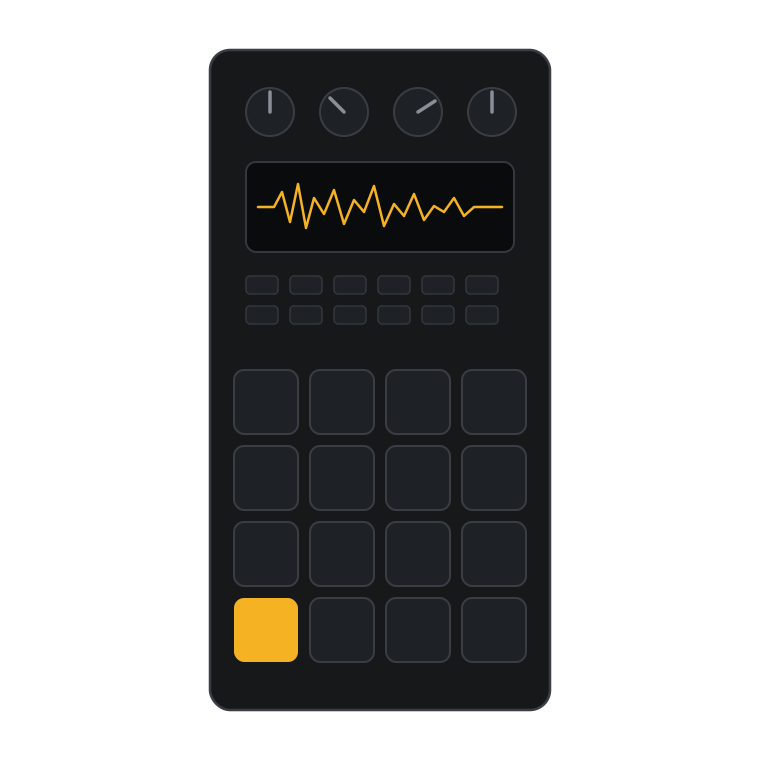
Illustration of a sixteen-pad sampler with a waveform display and four knobs THE SAMPLER BECOMES P–16
ROLAND SP-404 · 2005

A battery-powered sampler with a handle, built so a beat could be made anywhere. Its effects were the point — the vinyl simulator and the lo-fi crusher were characterful instead of clean, and a generation of producers used them as an instrument rather than a repair. It made the beat tape a form, and it is still the machine you see on a table at a live set.

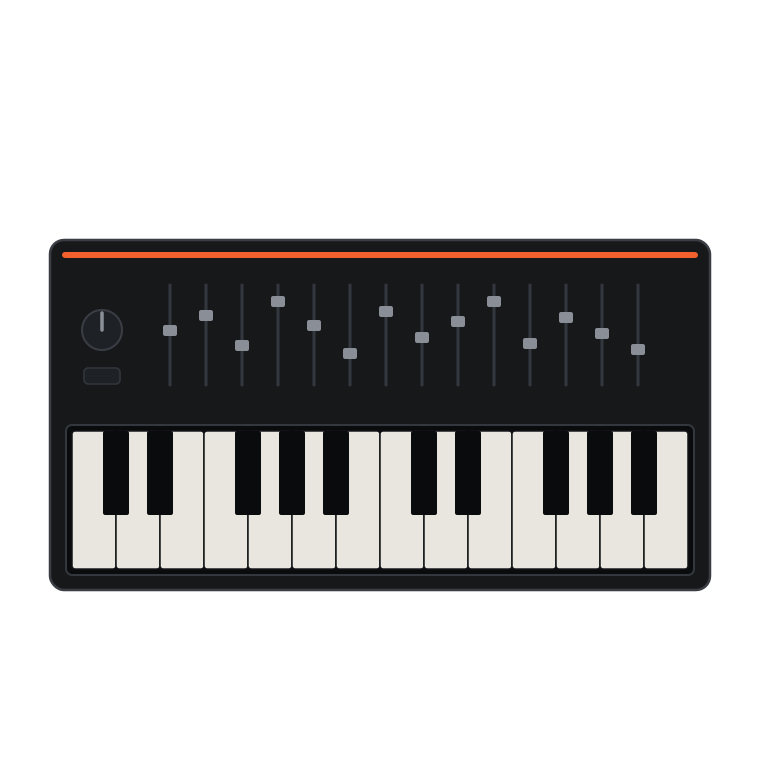
Illustration of a compact slider synthesizer with a two-octave keyboard THE SYNTH BECOMES J–17
ROLAND JUNO-106 · 1984

Six voices, one slider per function, and no menu anywhere. Its oscillators were digitally controlled, which meant it held its tuning when the analog polysynths around it drifted — an affordable keyboard that stayed in tune under stage lights. The chorus circuit is the reason it is still bought: switch it on and a thin patch becomes wide and wet, and that sound runs straight through house, synth-pop and everything after.

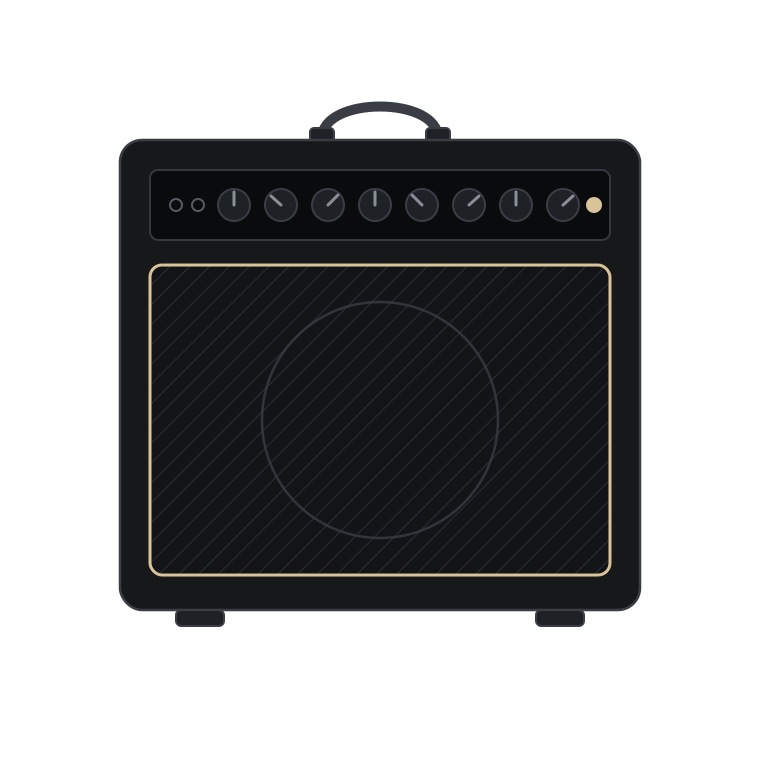
Illustration of a blackface combo amplifier with eight knobs, a jewel lamp and a leather handle THE AMP BECOMES D–65
FENDER DELUXE REVERB · 1965

Twenty-two watts, one 12-inch speaker, and a spring reverb tank bolted in the bottom. It was never the loudest amp Fender made, which is exactly why it ended up on more records than any of them — it breaks up at a volume a room can survive, and the reverb is the sound of a thousand surf and country records. Engineers still reach for one because it is honest at the edge instead of falling apart.

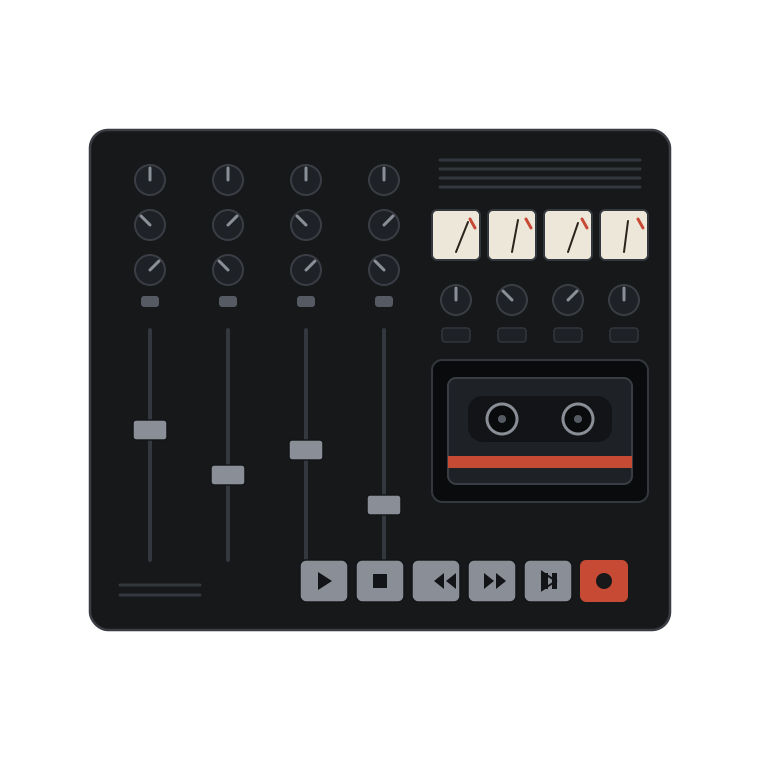
Illustration of a cassette multitrack recorder with faders, VU meters and transport keys THE DECK BECOMES T–6
TASCAM PORTASTUDIO 144 · 1979

The first cassette four-track: a mixer and a recorder in one box, cheap enough that a person could own the means of making a record. Before it, multitracking meant a studio and an hourly rate. Springsteen cut Nebraska on one and released the demo as the album. Home recording as a practice begins with this machine.

Tap a machine for its history

And they love the hardware back.

These aren't a replacement for the gear on your desk — they're its missing half. Wire your synth in over MIDI and load patches and patterns designed on the phone. Connect your drum machine and trade loops and packs with it. A symbiotic rig: the phone makes the hardware do more, and the hardware makes the phone sound real.

Nothing here is trying to beat the feel of a real instrument, and nothing will. What software can do is carry the craft forward — the same way the synth did when new capacitors and transistors made sounds possible that had never existed. Every era hands the instrument a new material. Glass and silicon are ours.

04The rig

One instrument, four faces

PHONE

The pocket rig. Always with you, and powerful enough to record full tracks — an idea anywhere can become a song.

TABLET

The same instrument on a bigger panel — more room for your hands, a more engaging way to play.

DESK

A real Mac app, not a port. The pocket rig and the studio rig are the same rig — neither is the demo of the other.

PLUGIN

Every instrument ships as an AUv3. Drop it on a track in Logic, Ableton Live, GarageBand or AUM — same sound, inside your DAW.

Plug in a real keyboard. Wire in a real guitar. Make sounds nothing else makes.

THE FERRIC RACK · $79 Each instrument's Mac app and AUv3 is $29.99 on its own — or take the whole Rack for $79 and save a third. Same machines, same names — the desk version is not a bigger version. Bought once, and S–7 and L–1 come along free.
BUILT FOR THE APPLE STACK

iPhone, iPad, Mac — one engine. The same audio code runs on all three, so a patch you build on the phone opens on the desk with the same latency and the same sound. Start an idea on the bus, finish it in Logic, and never rebuild it in between.

WHAT THAT MEANS TODAY

The Rack is AUv3 and Mac apps. It loads in Logic, Ableton Live, GarageBand, AUM and anything that hosts Audio Units. If your desk runs on a different stack, this is not the shelf for you yet — worth knowing before you buy, not after.

Going deep on one stack is the trade, and it buys something real: Core Audio and AUv3 are why a phone can hold a studio at all. Building on them properly beats spreading thin across four platforms and doing none of it well. The shelf grows as the shop can support it honestly — and anything you buy stays bought.

05Plug in

Real gear goes in the phone

Every one of these takes a cable. Not a toy jack, not a workaround — a class-compliant interface, the same one already on your desk, and the phone becomes the head of your rig. Your guitar, your keyboard, your drum machine, your voice — in, through the panel, and out as something that didn't exist before you plugged it in.

YOUR GUITAR, IN

Wire a Telecaster through an interface and D–65 is the amp at the end of the cable — a blackface Deluxe with the real tone network, a board of pedals at your feet, about 12 ms from jack to ear. Then keep going past what a tube amp can do: a quartz gate, a mineral spring, forty kilometers of desert tremolo. The same guitar, played somewhere it has never been.

YOUR KEYBOARD, IN

Any USB or Bluetooth MIDI controller plays J–17 with real keys under your hands — velocity, sustain, the whole span. Wire in a JU-06A and its sliders drive the panel one-to-one, both directions: two panels, one sound. The phone stops being the interface and goes back to being the instrument.

YOUR HARDWARE, BOTH WAYS

The traffic runs in both directions. Sample your drum machine into P–16, chop it, and send the kit back out to its card. Build a patch on the phone on the bus and load it into the rack when you get home. The phone makes the hardware do more; the hardware makes the phone sound real.

ANYWHERE, ON THE ROAD

This is the part a rack of gear can't do. Walk into any guitar shop, plug the interface into whatever is hanging on the wall, and you have your amp, your board, your tuner and a tape rolling — in your pocket. Try a guitar you don't own through a rig nobody else has. Then track it before you've left the store.

Studio and stage are the same rig, and it fits in a pocket. Not the small version of a real studio — a real studio that happens to be small.

06The kit

They play together

Every instrument runs in the background, so two or more can sound at once — a synth over a sampler over a tape machine, all on one phone. They keep one clock: MIDI clock inside the phone, Ableton Link across the room. Start a pattern on the P–16 and the J–17 falls in step; a friend's laptop joins the jam from the couch.

And they share one shelf. L–1 is the kit's library — every sound, pack, and patch any instrument makes, named by you, on every device you own. The tuner checks it, the sampler chops it, the synth voices it, the amp colors it, the tape commits it. One kit. Everything you need to record a track, in your pocket.

07The whole shelf

The whole studio for less than one plugin

This is what the family is for. Not six apps that happen to share a look — every tool you need to make a finished record, designed to work as one instrument. Sample and chop it, play it, amp it, tune it, track it, keep it. Nothing else to buy, nothing else to learn.

For an aspiring producer, that's the whole education in one place: a real signal chain you can see, panels labelled like the hardware they came from, and the freedom to try anything without breaking something expensive. For a working artist, it's the dream rig reduced to what fits in a pocket.

Four machines at $9.99 and two that cost nothing — or $29.99 for the Shelf, which is less than one decent plugin and less than a single month of most studio subscriptions. On the desk each one is $29.99 on its own, or $79 for the whole Rack. None of it renews.

Anything you can imagine, built and recorded on the phone already in your hand. That was the promise of this whole technology age. We're just building the part that got skipped.

08The deal

Priced like a tool, not a trap

An instrument should be worth more than it costs, and it should be obvious who it's for. These are priced so a kid with a used phone can own the whole shelf — and built so that trying something wild never costs you anything but time. Students and schools go further still, through the SDIT scholarships below.

  • BUY ONCE A machine is a purchase, never a subscription. Nothing expires, nothing needs renewing, and revisions are free.
  • NO DATA, EVER We don't collect your data. No analytics, no telemetry, no account. Your sounds and recordings stay on your device — we never see them, and never want to.
  • NO LOCK-IN, EVER Your work lives in plain folders you own — WAV, MIDI, files you can open in Finder. No proprietary format, no database, no export step to get your own work out. Everything works with or without Ferric; the instruments just make it a far better experience.
  • WORKS OFFLINE No server check, no phone-home. If the shop goes quiet tomorrow, every instrument you own keeps working.
  • WHAT YOU PAY BUILDS Every purchase funds the next machine — more instruments, deeper integrations, and the family growing into what it should be.

No dark patterns, no upsell screens, no manufactured scarcity. We're not trying to scheme money out of anybody — we're trying to build the instruments we wished existed, and sell them at a price that keeps the lights on.

09Scholarships

The SDIT Music Scholarship

FOR STUDENTS

Grants covering the full kit, for students learning music at any level. Tell us what you're studying and what you're trying to make — that's the whole application — and a code comes back. No proof of income, no essay.

[email protected]
FOR SCHOOLS

Educational rates and department grants — elementary through college, plus community programmes and private teachers. Write in and we'll set a rate for the class, the lab or the whole department: one instrument per student, not one licence for the room.

[email protected]

Underwritten by the San Diego Institute of Technology as part of its music programme. The instruments are already priced to be reachable; the scholarships exist so a classroom or a student learning the craft gets the whole kit — so somebody finds out what a filter does, and where all of this came from.

BENCH NOTE — Nº 001 JUL '26

Every one of these started the same way: a musician at a bench, annoyed that the most powerful device in the room was the one with no real instruments on it.

So we're building them. S–7 goes first because everyone needs a tuner. The rest of the line is right behind it.

Notes from here on out are short: one screenshot, one decision, no noise. The list hears everything first.

— the bench, San Diego
10Beta testing · free

Test them free.

Every machine is in TestFlight beta right now — free to test, on your own phone, before any of it reaches the store.
Bench notes while they're built, and release day when it comes. Nothing else, ever.

Free TestFlight invites · double opt-in · unsubscribe any time